
Published on July 10, 2025
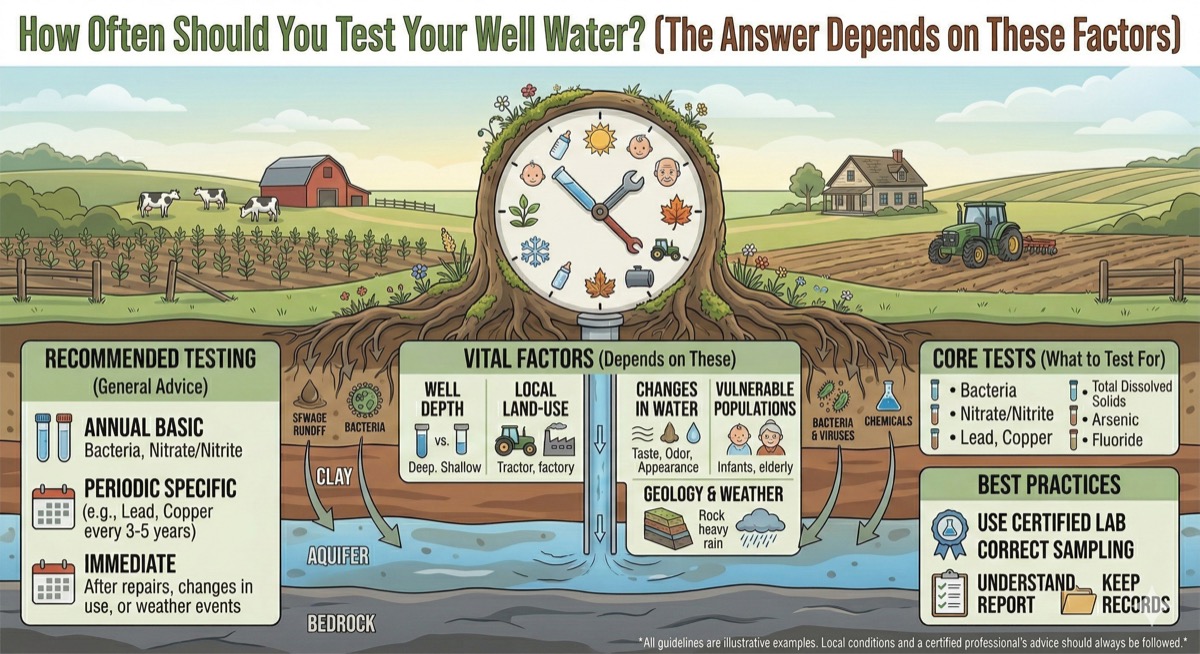
How Often Should You Test Your Well Water? (The Answer Depends on These Factors)
The short answer: at least once a year. The longer answer depends on where you live, what's around your well, and what's happened recently.
The Baseline: Annual Testing
The CDC, EPA, and most state health departments recommend testing private well water at least once per year — minimum for coliform bacteria (coliform/E. coli) and nitrates. These are the contaminants most likely to change from year to year based on weather, land use, and seasonal conditions.
Annual testing isn't paranoia. It's maintenance. Your car gets an oil change every year. Your well water gets a test.
Test More Frequently If...
Certain conditions call for more than annual testing:
After a flood or heavy rainfall Surface water carries bacteria, nitrates, and agricultural chemicals. If your well was submerged or floodwater got near it, test immediately before drinking.
After nearby construction or drilling Excavation can disrupt underground water flow and introduce contaminants. Test before resuming normal use.
If you notice changes in taste, smell, or appearance Sulfur smell, metallic taste, cloudiness, oily sheen — any change is worth investigating immediately. Don't wait for your annual test.
If someone in your home is pregnant, an infant, elderly, or immunocompromised More vulnerable household members warrant more frequent bacteria testing. Some experts recommend every 6 months.
If a neighbor's well tests positive for contamination Aquifers are shared. If a neighboring well turns up arsenic, bacteria, or PFAS, test yours too.
After well repairs or pump replacement Any work on the well itself can introduce contaminants. Test before drinking after any service work.
If you're in an agricultural area during planting/harvest season Fertilizer and pesticides applications peak seasonally. Nitrate levels in particular can spike after spring planting.
Contaminant-Specific Testing Schedules
Not everything needs to be tested every year. Here's a practical schedule:
| Contaminant | Recommended Frequency |
|---|---|
| Bacteria / E. coli | Annually (more after floods/repairs) |
| Nitrates | Annually |
| pH | Every 2–3 years |
| Hardness / iron and manganese / Manganese | Every 2–3 years |
| Arsenic | Every 3–5 years (or once if you've never tested) |
| lead | Once; again after plumbing changes |
| PFAS | Once baseline; again if local sources identified |
| radon | Once baseline |
| Pesticides / VOCs | Every 3–5 years in at-risk areas |
A Simple Rule
Test bacteria and nitrates every year. Test everything else at least once to establish a baseline — then re-test anything that was elevated, or if your situation changes.
Ready to test? Find a find a lab in your state using our directory, or find a mail-in kit if there's no lab nearby.