
Published on June 29, 2025
How to Read Your Well Water Test Results (Without a Chemistry Degree)
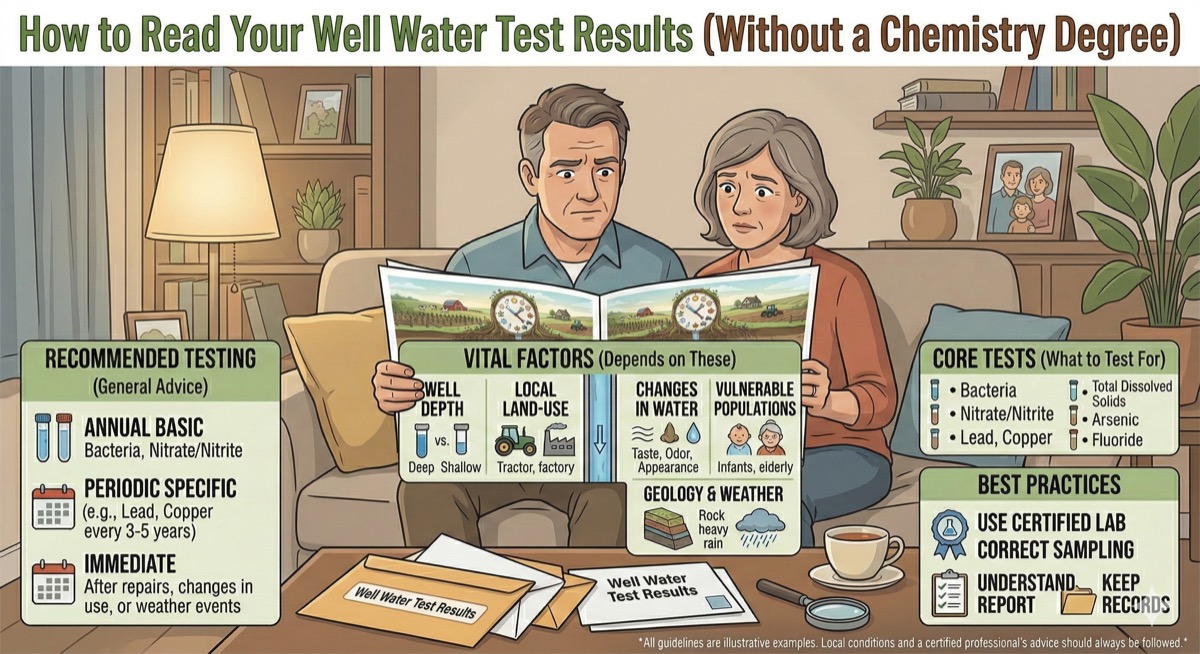
You got your well water test results back. Now you're staring at a table full of numbers, abbreviations, and units you've never seen before. What does it all mean?
Here's a plain-English guide.
The Basic Structure
Most lab reports follow the same format. For each contaminant tested, you'll see:
- Parameter — What was tested (e.g., "Total coliform bacteria," "nitrates as N," "arsenic")
- Result — What was found in your sample, in specific units
- Units — How the result is measured (mg/L, µg/L, CFU/100mL, etc.)
- MCL — Maximum Contaminant Level (the EPA's legal limit for public water)
- Status — Often "Pass/Fail," "Detected/Not Detected," or flagged with an asterisk
Understanding the Units
The units can be confusing. Here's a quick reference:
| Unit | Meaning | Used for |
|---|---|---|
| mg/L | Milligrams per liter (= ppm, parts per million) | Nitrates, iron and manganese, hardness, most common |
| µg/L | Micrograms per liter (= ppb, parts per billion) | Arsenic, lead, heavy metals |
| ng/L | Nanograms per liter (= ppt, parts per trillion) | PFAS |
| CFU/100mL | Colony forming units per 100 mL | Bacteria |
| pCi/L | Picocuries per liter | radon |
What the MCL Means (and Doesn't Mean)
The MCL is the EPA's enforceable limit for public water systems. It's set based on a balance between health risk and what's technically and economically achievable to treat.
Important caveats:
- The MCL is not a "safe" line — it's a regulatory threshold. Some health advocates recommend acting at levels below the MCL for certain contaminants (arsenic, PFAS, lead).
- Private wells aren't legally required to meet MCLs — the rules apply to public water systems. But MCLs are still your best reference point.
- "Not Detected" doesn't mean zero — it means below the lab's detection limit, which is a very small amount. This is fine for most contaminants.
Common Results Explained
Total Coliform: Absent / Present Absent = good. Present = action needed. Your lab report should also test specifically for E. coli if total coliform is present. Any detection of E. coli is a serious finding requiring immediate action (don't drink the water, call your health department).
Nitrate: X mg/L (MCL = 10 mg/L) Below 10 mg/L is acceptable. Above is a concern, especially for infants. Between 5–10 mg/L is worth watching.
pH: X (ideal range 6.5–8.5) Below 6.5 is acidic — can corrode pipes and leach metals. Above 8.5 is basic — usually not a health concern but affects taste and can cause scale buildup.
Arsenic: X µg/L (MCL = 10 µg/L) Some researchers recommend treatment at levels above 3–5 µg/L, below the EPA MCL. Even "non-detect" for arsenic is reassuring.
Lead: X µg/L (action level = 15 µg/L) Lead in well water usually comes from plumbing, not the aquifer. The EPA's action level is 15 µg/L, but the agency says there is no safe level of lead exposure. Any detection warrants investigation of your plumbing.
PFAS: X ng/L (EPA limits: 4 ng/L for PFOA/PFOS) The EPA's 2024 rule sets limits at 4 parts per trillion — incredibly small amounts. If your report shows any PFAS above these limits, consult your health department.
Iron/Manganese: X mg/L Iron MCL is 0.3 mg/L; manganese is 0.05 mg/L. These are secondary standards (aesthetic, not health-based) — but elevated levels cause staining, taste issues, and can clog pipes.
What to Do If Something is Flagged
- Don't panic — one result above an MCL doesn't mean your water is immediately dangerous (except bacteria — act immediately on that)
- Call your county health department — most offer free consultation on well water results
- Get a second test — if a result surprises you, confirm it with a re-test before spending money on treatment
- Talk to a water treatment specialist — treatment options exist for almost every contaminant
Keep Your Results
Store your test results somewhere you won't lose them. They're your baseline. When you re-test next year, you'll want to compare. They're also useful documentation if you ever sell the property.
Need to re-test or test for additional contaminants? Find a find a lab in your state using our directory.