
Published on December 31, 2025
Just Drilled a New Well? Here's Everything You Should Test For First
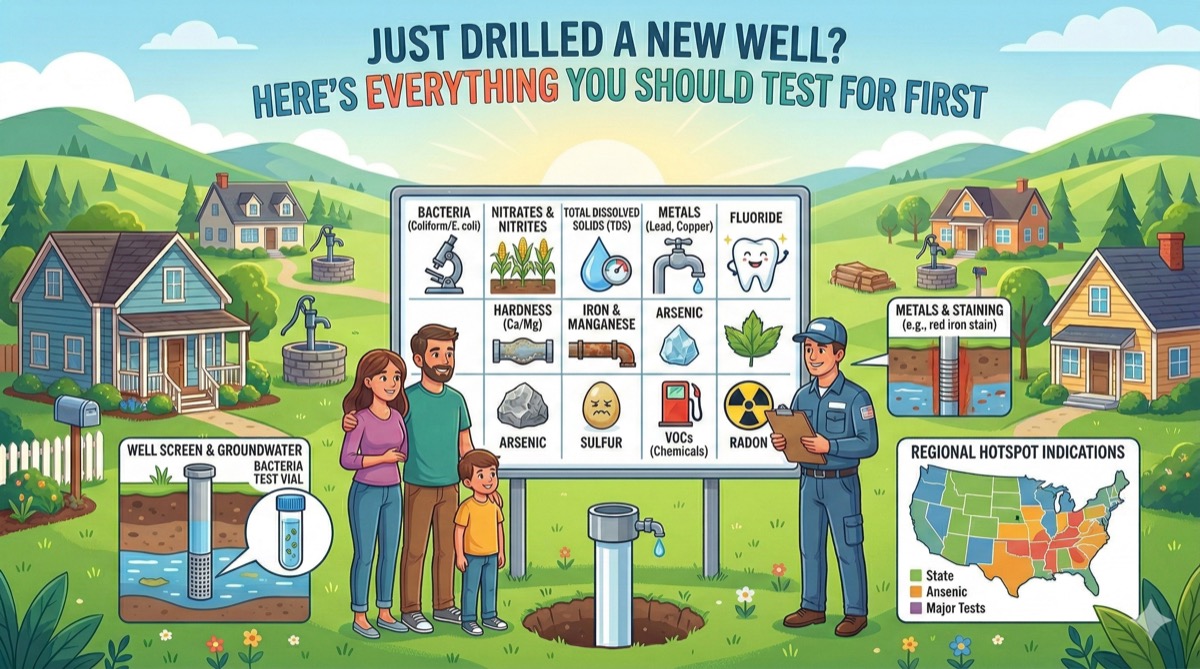
A new well is a major investment. Before you start using it for drinking water, you need to know what's in it. A baseline test isn't just smart — for many mortgages and county health permits, it's required.
Here's what to test for, and why.
Why a Baseline Test Matters
When you test a new well, you're establishing your starting point. If something changes in five years — a neighbor starts farming, a gas station opens nearby, your water starts tasting different — you'll want to know what "normal" looked like. Without a baseline, you're guessing.
You also want to catch any issues introduced during drilling. New wells can have elevated turbidity, coliform bacteria introduced during the drilling process, and residual drilling fluids that need to flush out.
Step 1: Initial Flush
Before collecting any test sample, pump the well to flush out sediment and any materials introduced during drilling. Your well contractor will typically do this during development, but run it until the water runs clear before testing.
What to Test For in a New Well
Mandatory First Tests
Bacteria (total coliform and E. coli) Any new well should be tested for bacteria before use — drilling introduces potential contamination pathways. Many lenders and health departments require this.
nitrates A baseline nitrate reading tells you what you're starting with. In agricultural areas, this is critical.
pH Affects taste, pipe corrosion, and treatment system effectiveness.
Strongly Recommended
Comprehensive metals panel Includes arsenic, lead, iron and manganese, manganese, chromium, barium, and others. Gives you a full picture of what's naturally in your aquifer.
Hardness Tells you whether you'll want a water softener and helps size treatment equipment.
Total dissolved solids (TDS) An overall indicator of mineral content and water quality.
radon (New England, Appalachia, parts of Midwest) Test while you still have time to address it before the house is complete.
Test Based on Your Location
Arsenic — Western states, New England: absolutely test for this PFAS — If you're near a military base, airport, industrial area, or farmland that received biosolids Agricultural chemicals — If you're in a farming area VOCs (VOCs) — If you're near industrial facilities, gas stations, or known contamination sites uranium — Western states, Great Plains
For the Deepest Peace of Mind
A comprehensive panel covering 50–100 parameters runs $200–$400 and is the right choice for a new well. You're making a decision about a water source you'll potentially use for decades. The cost of a thorough test is trivial compared to the investment in the well itself.
What Happens If Something Is Found?
New wells occasionally test positive for bacteria — often from the drilling process rather than the aquifer itself. Shock chlorination typically resolves this, followed by re-testing.
For naturally occurring contaminants like arsenic or hardness, your well contractor and a water treatment specialist can recommend appropriate treatment before you begin using the water.
Keep Your Results Forever
File your baseline test results with your property documents. They're useful when you sell the property, and essential context for interpreting future tests.
Ready to test your new well? Find a find a lab in your state using our directory — many labs work directly with well contractors and can turn results around quickly.