
Published on January 15, 2026
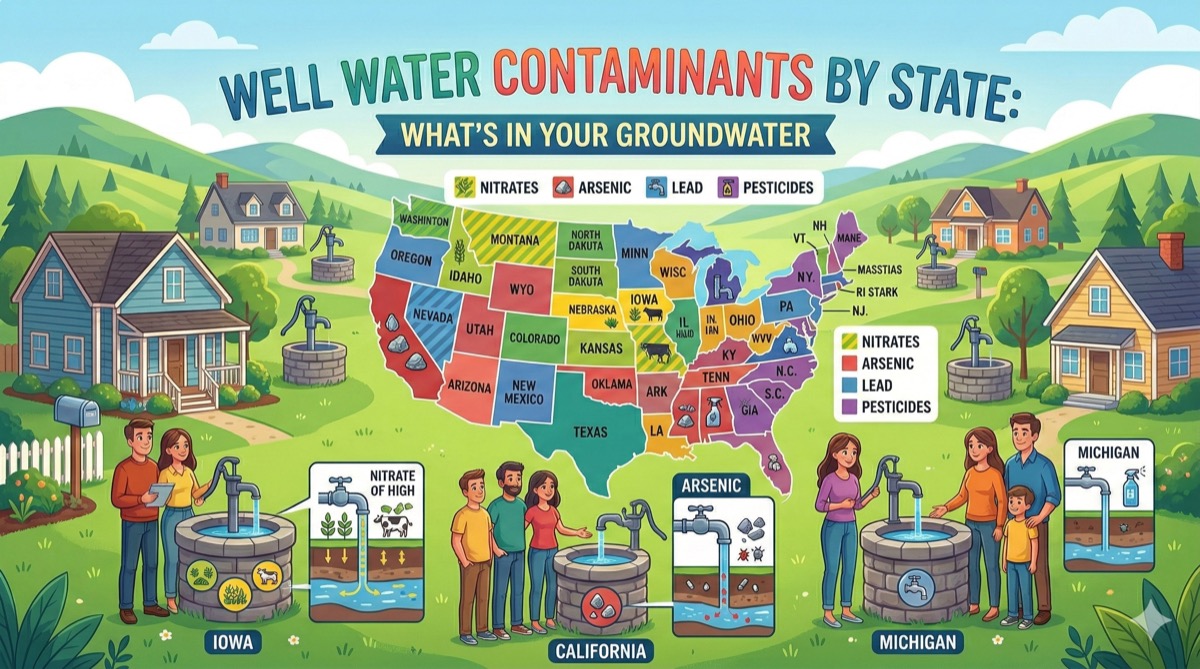
Well Water Contaminants by State: What's in Your Groundwater
Private well water quality varies dramatically across the United States. What's a concern in Arizona may not be relevant in Vermont — and vice versa. This guide gives you a state-by-state overview of the contaminants most commonly found in private wells, so you know what to prioritize when testing.
How to Use This Guide
This isn't a definitive scientific survey — it's a practical starting point based on USGS groundwater data, state health department advisories, and regional geology. Your individual well may be different. Local geology, land use, and well depth all affect your specific water quality.
Use this to identify what to add to your test panel beyond the basics (coliform bacteria and nitrates) that every well owner should test for.
Northeast
Maine
Priority contaminants: arsenic, radon, uranium, iron and manganese Maine has some of the highest naturally occurring arsenic levels in the country due to bedrock geology. Radon is also prevalent. Test for both before assuming your well is safe.
New Hampshire
Priority contaminants: Arsenic, radon, uranium Similar geology to Maine. Granite bedrock releases arsenic and uranium into groundwater. Radon levels among the highest in the nation.
Vermont
Priority contaminants: Arsenic, radon, nitrates (agricultural areas) Arsenic from metamorphic rock is common. Agricultural runoff affects some areas.
Massachusetts, Connecticut, Rhode Island
Priority contaminants: Arsenic, radon, PFAS (near military sites) Significant PFAS contamination near military installations (Otis Air Base, etc.).
New York, Pennsylvania, New Jersey
Priority contaminants: Radon, arsenic, PFAS, VOCs (industrial areas) Wide variation by region. Industrial history in some areas creates VOC concerns. PFAS contamination near military bases and manufacturing sites.
Southeast
Virginia, West Virginia
Priority contaminants: Arsenic, iron, manganese, VOCs (coal regions) Appalachian geology contributes arsenic. Coal country areas have additional concerns.
North Carolina, South Carolina
Priority contaminants: Arsenic, iron, manganese, PFAS (near military bases) Significant PFAS contamination documented around Camp Lejeune and other military installations.
Georgia, Alabama, Mississippi
Priority contaminants: Iron, manganese, bacteria, nitrates Agricultural runoff and septic system density are primary concerns.
Florida
Priority contaminants: Nitrates, bacteria, sulfur (hydrogen sulfide), arsenic Florida's shallow aquifer system and extensive agricultural activity drive nitrate concerns. Hydrogen sulfide is common, especially in South Florida.
Midwest
Iowa, Illinois, Indiana, Ohio
Priority contaminants: Nitrates, bacteria, atrazine and other pesticides The heart of the Corn Belt. Nitrate contamination from agriculture is widespread and well-documented. The USGS has found nitrates above the MCL in a significant percentage of private wells tested in this region.
Missouri, Kansas, Nebraska
Priority contaminants: Nitrates, arsenic, uranium, atrazine Great Plains aquifers in western areas contain naturally elevated uranium and arsenic. Eastern areas face heavy agricultural chemical pressure.
Minnesota, Wisconsin, Michigan
Priority contaminants: Arsenic, nitrates, PFAS (near 3M/military), manganese PFAS contamination around the Twin Cities area (3M manufacturing legacy). Arsenic in crystalline bedrock aquifers in northern Minnesota and Wisconsin.
South Central
Texas
Priority contaminants: Arsenic, nitrates, radium, uranium, fluoride West Texas aquifers have elevated naturally occurring arsenic, radium, and uranium. Very large state with wide variation.
Oklahoma, Arkansas
Priority contaminants: Nitrates, bacteria, arsenic Agricultural state concerns (nitrates, bacteria) combined with geologic arsenic in some areas.
Louisiana
Priority contaminants: Bacteria, nitrates, iron Shallow wells in humid climate — bacteria is the top concern.
Mountain West
Colorado, Wyoming, Montana
Priority contaminants: Arsenic, uranium, nitrates, selenium Rocky Mountain geology releases arsenic and uranium. Mining-affected areas have additional metal concerns.
Nevada, Utah, Idaho
Priority contaminants: Arsenic, uranium, fluoride, selenium Desert Southwest aquifers have naturally elevated arsenic throughout much of Nevada and Idaho.
Arizona, New Mexico
Priority contaminants: Arsenic, uranium, fluoride, nitrates (agricultural areas) Some of the highest naturally occurring arsenic levels in the country. Test before assuming your water is safe.
Pacific West
California
Priority contaminants: Arsenic, nitrates, 1,2,3-TCP (agricultural chemical), PFAS Central Valley has significant nitrate and agricultural chemical contamination. Arsenic is elevated in many areas. 1,2,3-TCP (a fumigant byproduct) is a specific California concern.
Oregon, Washington
Priority contaminants: Arsenic, nitrates, VOCs (industrial areas), manganese Volcanic geology contributes arsenic and manganese in some areas. Agricultural nitrates in eastern portions of both states.
What Every Well Owner Should Test For (Regardless of State)
No matter where you live:
- Coliform bacteria — Annually
- Nitrates — Annually
- pH, hardness, iron, manganese — Baseline and every few years
- Arsenic, lead, uranium — Baseline test at minimum
- PFAS — If near military installations, industrial sites, or airports
Find a find a lab in your state using our directory. Filter by state to see labs that accept samples from your area.