
Published on October 7, 2025
Why Does My Well Water Smell Like Rotten Eggs? (And What to Do About It)
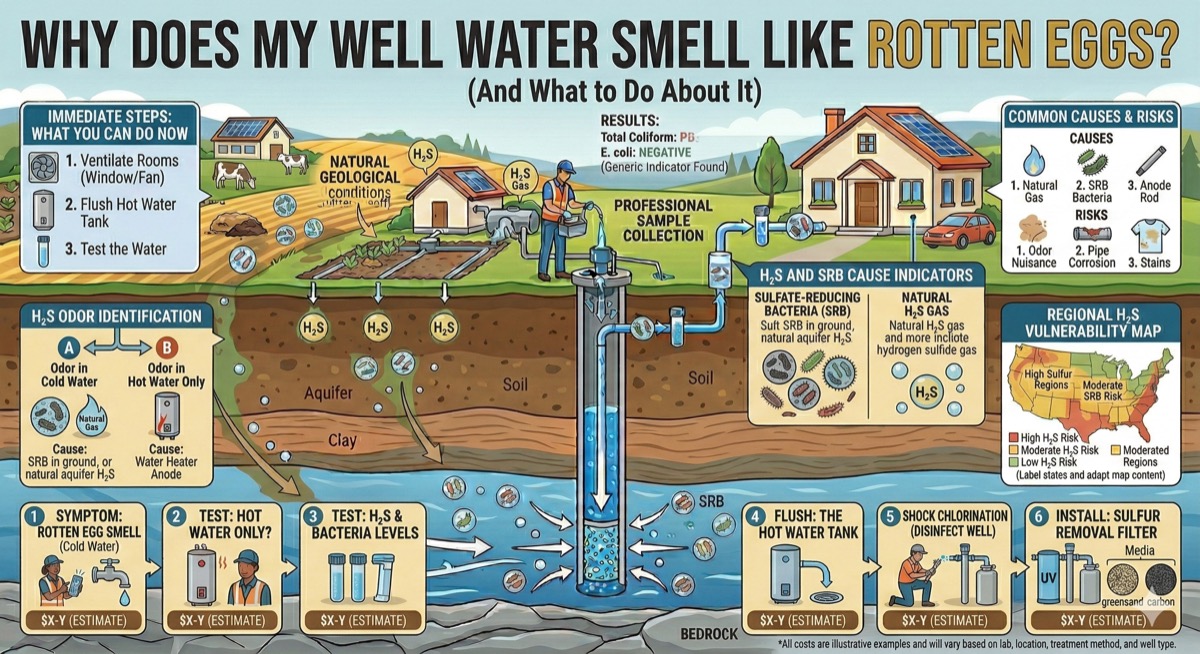
If your well water has a strong rotten egg smell, you're dealing with hydrogen sulfide gas (H₂S) — a naturally occurring compound that's common in well water, especially in certain geologic areas.
The good news: it's usually more of an aesthetic problem than a health emergency. Here's what's happening and what you can do about it.
What Causes the Rotten Egg Smell?
Hydrogen sulfide in well water comes from a few sources:
1. Naturally occurring sulfur coliform bacteria Sulfur bacteria live in soil and groundwater and produce hydrogen sulfide as a byproduct. They're not typically harmful themselves, but their presence changes your water's chemistry.
2. Geologic sulfur deposits Some aquifers naturally contain hydrogen sulfide gas dissolved in the water. This is purely geological — no bacteria involved.
3. Your water heater If the smell only comes from your hot water tap (not cold), the problem is almost certainly your water heater. Water heaters have a magnesium anode rod that can react with sulfur bacteria, producing hydrogen sulfide in the hot water tank. This is a fixable appliance issue, not a well issue.
4. Bacteria in the well itself If the smell comes from both hot and cold taps, there may be sulfur bacteria living in the well or distribution pipes.
Is Hydrogen Sulfide Dangerous?
At the low concentrations typically found in well water, hydrogen sulfide is not a health risk for drinking — it's primarily an aesthetic issue (taste, smell, potential for staining).
At very high concentrations (which are rare in drinking water), H₂S can be toxic, but you'd smell it at levels far below dangerous exposure thresholds. If the smell is overwhelming or causes symptoms like headaches or nausea, that warrants immediate action.
What to Do
Step 1: Figure out where it's coming from
- Smell from hot water only → water heater issue
- Smell from cold water only → well or pipes
- Smell from both → likely the well or aquifer
Step 2: Test your water A sulfur smell is a signal to get a full test, not just a hydrogen sulfide test. Check for bacteria (coliform/E. coli), iron and manganese, manganese, and pH at the same time. Sulfur bacteria often co-occur with iron bacteria.
Step 3: Treat the source
If it's the water heater:
- Replace the magnesium anode rod with an aluminum/zinc rod
- Raise the water heater temperature to 160°F for a few hours to kill bacteria (caution: scalding risk, turn it back down afterward)
- Flush the tank
If it's the well:
- Shock chlorination kills sulfur bacteria and usually eliminates the smell — temporarily. If it comes back, you may need ongoing treatment.
- Aeration systems physically remove dissolved hydrogen sulfide gas before it enters your home
- Activated carbon filters reduce sulfur smell at point of use
- Chemical feed systems (chlorine or hydrogen peroxide injection) provide continuous treatment for severe cases
Will It Go Away on Its Own?
Sometimes yes — hydrogen sulfide levels can fluctuate with water table changes and seasons. But if the smell has been consistent, it's not going away without treatment.
If you're dealing with a sulfur smell, start with a full water test to understand what you're working with. Find a find a lab in your state using our directory.