
Published on December 10, 2025
How Much Does Well Water Testing Cost? A Complete Price Breakdown
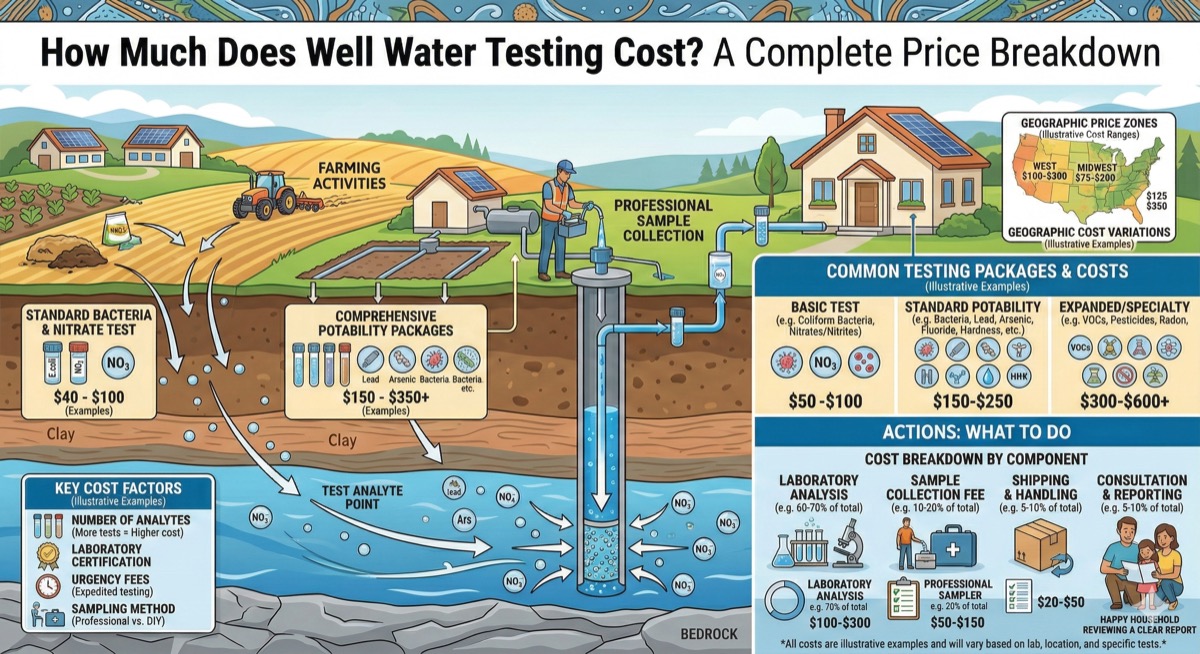
Water testing prices vary widely depending on what you're testing for and which lab you use. Here's a realistic breakdown of what to expect — and where to find affordable certified testing.
Quick Summary
| Test Type | Typical Cost |
|---|---|
| Basic coliform bacteria + nitrates | $40–$100 |
| Standard panel (10–20 parameters) | $100–$200 |
| Comprehensive panel (50+ parameters) | $200–$400 |
| PFAS testing (6 EPA compounds) | $75–$200 |
| arsenic only | $15–$40 |
| lead only | $20–$50 |
| Full VOCs panel | $100–$200 |
| radon | $25–$75 |
Basic Testing: $40–$100
A basic test covering coliform bacteria and nitrates is the minimum recommended annual test for private well owners. At most certified labs, this runs $40–$100 depending on your state and lab.
Some county health departments offer subsidized testing at lower cost — worth checking before going to a private lab. For most rural well owners, mail-in testing is the practical option since a certified local lab may not exist within a reasonable drive.
Standard Panel: $100–$200
A standard or "essential" panel typically adds:
- pH, hardness, iron and manganese, manganese
- Total dissolved solids (TDS)
- Sulfate, chloride, sodium
- Possibly arsenic and lead
This is the right starting point if you've never tested before or haven't tested in several years. For $100–$200 you get a real picture of your water.
Comprehensive Panel: $200–$400
A comprehensive panel covers 50–100+ contaminants including heavy metals, volatile organic compounds (VOCs), agricultural chemicals, and in some cases PFAS. If you have specific concerns about your area, are buying a home, or just want full peace of mind, a comprehensive panel is worth it.
Add-On Tests
PFAS: $75–$200 for the six EPA-regulated compounds. Some labs offer broader PFAS panels (40+ compounds) for more. Worth adding if you live near military bases, airports, or industrial sites.
Radon: $25–$75. Particularly relevant in New England, Appalachia, and parts of the Midwest.
pesticides/herbicides: $50–$150 as an add-on. Important in farming communities.
Mail-In Testing vs. Local Lab
For most well owners today, mail-in is the default — not because it's the flashy option, but because most people simply don't live near a certified lab. If the nearest lab is an hour away, a mail-in kit is the realistic choice, and the results are just as valid.
Mail-in kits are typically in the $80–$300 range for comprehensive panels and include:
- Sample containers shipped to you
- Prepaid return shipping (in most cases)
- Results by email
Pricing is competitive, and the lab work is performed by the same types of certified facilities you'd use in person. Tap Score is one of the more highly-rated mail-in options (4.9 stars, 252 reviews) and a good benchmark for what to expect on price and turnaround. The main tradeoff: you're handling the sample yourself, and bacteria samples are time-sensitive (must arrive at the lab within 24–48 hours).
Local certified labs are worth using if one is accessible — you can drop off a sample in person, which removes the shipping clock from the equation. Pricing is similar to mail-in, sometimes lower for basic tests.
What Affects the Price?
- Number of parameters tested — More tests = higher cost
- Lab certification level — Some certifications require more rigorous methodology
- Turnaround time — Rush processing costs more (typically +$25–$75)
- Location — Urban labs in competitive markets may charge less than rural labs
- State-specific programs — Some states subsidize testing for low-income households
How to Save Money
- Bundle tests — A comprehensive panel is almost always cheaper per-contaminant than running individual tests
- Check your county health department — Many offer free or discounted testing for residents
- Test strategically — Run a full comprehensive panel once, then test only for what you found or what's specific to your annual risks
Is It Worth It?
A comprehensive well water test costs less than a single restaurant dinner for a family. The potential cost of not testing — treatment for a waterborne illness, remediation of a contaminated well, or health effects from long-term exposure — is orders of magnitude higher.
Use our lab directory to find certified labs in your state and compare options, including mail-in services that ship anywhere in the country.