
Published on December 30, 2025
Nitrates in Well Water: Risks, Sources, and What to Do
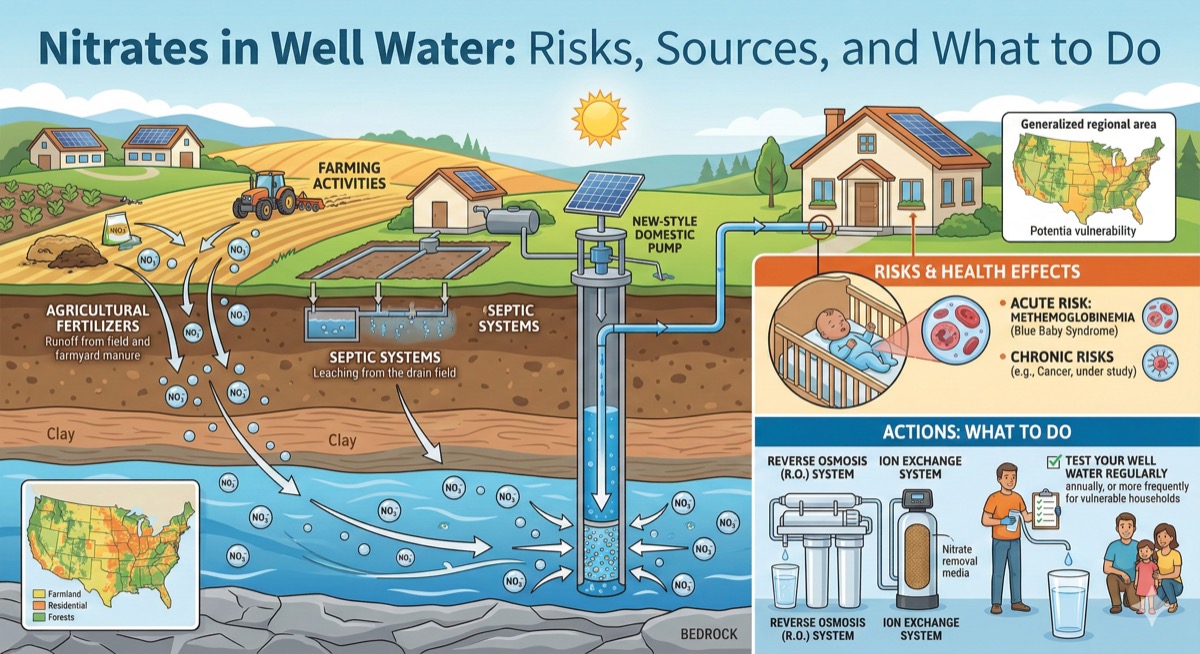
nitrates are one of the most common groundwater contaminants in the United States — and one of the most important to test for if you have a private well in an agricultural area. Here's what you need to know.
What Are Nitrates?
Nitrates (NO₃⁻) are nitrogen-containing compounds that occur naturally in soil and water at low levels. The problem is when human activity drives concentrations too high.
Sources of elevated nitrates in well water:
- Fertilizers — Synthetic nitrogen fertilizers applied to crops leach through soil into groundwater
- Septic systems — Improperly maintained or too-close septic systems release nitrates
- Animal waste — Livestock operations and manure storage near wells
- Decaying organic matter — Natural decomposition, though usually at lower levels
Who Is At Risk?
Infants under 6 months are the most vulnerable. Nitrates are converted to nitrite in the body, which interferes with the blood's ability to carry oxygen. In infants, this can cause "blue baby syndrome" (methemoglobinemia) — a potentially fatal condition.
Adults generally process nitrates efficiently, but long-term exposure above EPA limits is associated with increased cancer risk and thyroid effects.
The EPA Standard
The EPA's MCL for nitrates in public water is 10 mg/L (as nitrogen). This limit was set specifically to protect infants. For adults, some health organizations suggest concern at levels above 5 mg/L for long-term exposure.
Where Is the Risk Highest?
Nitrate contamination is concentrated in:
- Corn Belt states — Iowa, Illinois, Indiana, Ohio, Nebraska, Kansas
- California's Central Valley
- Other intensive agricultural regions
- Areas with high septic system density
The USGS has mapped nitrate concentrations across the country, and significant portions of rural America exceed or approach the 10 mg/L limit.
Testing for Nitrates
A nitrate test is inexpensive ($15–$30 as a standalone, often included in basic panels). It should be done:
- Annually for all well owners in agricultural areas
- Before giving well water to infants
- When buying a home in a rural area
- After nearby farming activity or heavy fertilizer application
What to Do If Levels Are High
Do not use the water for infants if nitrates exceed 10 mg/L. Use bottled water or a certified treatment system until the problem is resolved.
Treatment options:
- Reverse osmosis (RO) — Most effective, removes 90%+ of nitrates. Works at point-of-use (under-sink) or whole-house.
- Ion exchange (anion exchange) — Effective for whole-house nitrate removal. More complex than RO.
- Distillation — Effective but slow and energy-intensive.
Note: standard carbon filters, water softeners, and sediment filters do not remove nitrates.
Address the source if possible:
- Check your septic system — it may need maintenance
- Consider the distance between your well and any agricultural activity
- Talk to your county extension office about best management practices if you farm your own land
A Note on Seasonal Variation
Nitrate levels in well water often peak in spring and early summer, after fertilizer application and spring rainfall drive nitrogen into groundwater. If your annual test is in fall, you may be missing the seasonal peak. In high-risk areas, consider testing in spring as well.
test your well for nitrates with a find a lab. Find one in your state using our directory — or find a mail-in kit if there's no local lab nearby.